

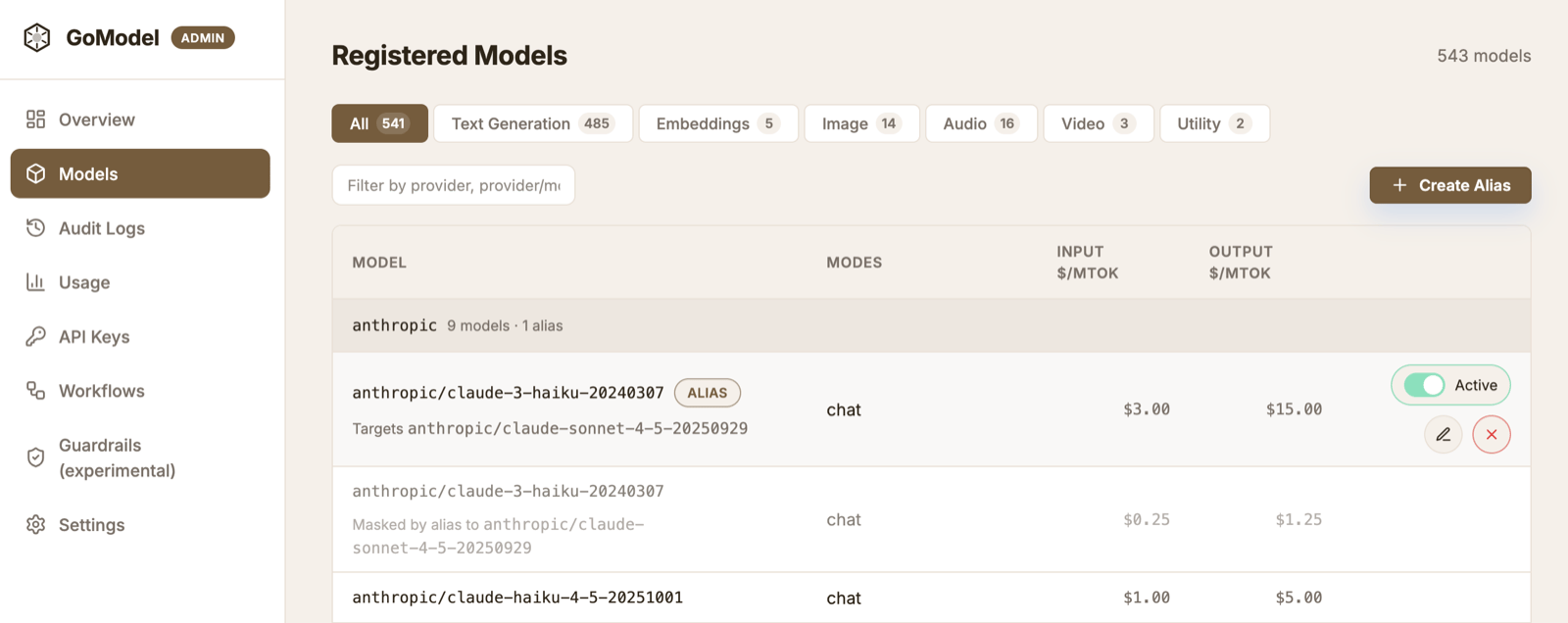
What virtual models do
A virtual model is a model you define, instead of one a provider advertises. GoModel picks the kind from whether you give it a target:- A redirect (an alias) is a stable name that points to a concrete provider
model. Your app sends the name in the
modelfield, and GoModel resolves it before sending the request upstream. - An access policy has no target. It gates an existing model selector by
user_path— or disables it entirely — without adding a new name. See User Path for access control.
Models -> New virtual model.
Fill Target model to make a redirect; leave it empty to make an access
policy on the Source selector.
GoModel does not persist empty, ineffective access policies, whether saved from
the dashboard or through the admin API. If a saved policy has no target, user
paths, description, or slowdown and its enabled state matches the inherited/default
access state, GoModel removes the stored row. It retains an otherwise empty
policy when that row still overrides a disabled default or an inherited
user-path restriction.
Add artificial model latency
Set Slowdown on a concrete model or redirect to add a fraction of measured inference time. Active values range from0.1 to 10; for example, 0.5
adds 50%, so a response that takes 2 seconds upstream is returned after about
3 seconds. Set 0 to explicitly disable slowdown, including slowdown inherited
from a concrete model. Leaving the field empty leaves the setting unspecified.
Delays honor request cancellation.
For streamed responses — Chat Completions and Responses API SSE, and the
audio endpoints — GoModel drains the upstream in
the background and releases each read chunk on the scaled timeline. This
preserves the provider’s relative chunk timing while delayed chunks accumulate
in memory. A large factor on a long or high-volume stream, or on a large audio
response, can therefore use substantial memory; leave slowdown unset in
production, where it has no purpose. Realtime WebSocket sessions are not slowed.
When an alias and its concrete target both have a slowdown, the alias value
wins. An alias without its own value inherits the selected target model’s
slowdown; set the alias to 0 to override that inheritance. This also applies
to load-balanced virtual models after a target is selected.
The rest of this page covers redirects.
Use stable names
You can expose names likeregular and smarter instead of provider-specific
model IDs.
regular->anthropic/claude-sonnet-4-6smarter->anthropic/claude-opus-4-6
Load balance across models
A redirect can point at several target models and spread requests across them. Add more than one target in the editor (Add target) and pick a strategy:- Round-robin (default) rotates requests evenly across the targets. Set a
per-target weight to bias the share — a target with weight
2receives twice the traffic of a target with weight1. - Lowest cost routes every request to the cheapest currently-available target, ranked by the model registry’s input + output per-token price. When a target has no registry pricing it is skipped while a priced target exists; if none are priced, the first listed target is used.
- Failover always routes to the first currently-available target in the order listed: the targets form a priority list, and lower entries serve only while every entry above them is unavailable or fails. Weights and session keeping do not apply.
- Adaptive (GoModel Pro) picks the target with the best observed latency, error rate, and price, backs off rate-limited or failing targets, and keeps a session on the provider whose prompt cache is warm. See Intelligent Routing. On an open-source build the strategy falls back to round-robin.
- Plugin (
strategy: plugin) delegates the choice to a loaded routing strategy plugin named bystrategy_plugin, configured per redirect throughstrategy_config. The built-incheapest_healthyprefers the cheapest (or fastest) target whose recent error rate is acceptable. Weights do not apply; if the plugin fails or is missing, the redirect falls back to weighted round-robin.
failover: false as code) switches that
off for one redirect, so a failed request is answered with the error instead;
it can also be switched off globally or by the request’s workflow. See
Failover for the errors that trigger a retry and for
adding a failover chain to a real model by shadowing it.
Requests belonging to one detected client session stick to the target that
served the session first (Session keeping, on by default), so
conversations keep their provider prompt cache warm across turns. Untick the
editor’s Session keeping checkbox (or set session_affinity: false) to
restore stateless balancing — see
Session Keeping.
smart at both openai/gpt-4o and anthropic/claude-sonnet-4-6
with the round-robin strategy to split load, or at a premium and a budget model
with the cost strategy to always take the cheaper one.
Reorder targets
The target list is an ordered list, and the editor keeps it editable: drag the grip handle (☰) at the left edge of each target row onto another row to change its position. The drop row is not replaced — the dragged row moves into its position and the rows in between shift. Keyboard users can focus the handle and press ArrowUp / ArrowDown for the same move. The handle shows only when the redirect has more than one target, and every strategy benefits: for failover the order is the priority chain (position1 is tried first), for the balancing strategies position 1 is the first
slot in the queue. Weights and explicit provider pins stay attached to their
target when it moves.
Chain virtual models
A redirect target can name another virtual model instead of a concrete model. The inner virtual model is resolved at request time, so its targets, weights, and strategy are defined once and reused everywhere it is referenced — no duplicated target lists that drift apart.- The cost strategy prices a chained leg at the cheapest concrete model currently available behind it.
- A chained virtual model that is disabled, or has no available target, is skipped like an unavailable provider model.
- Only the outer virtual model’s
user_pathsandslowdownapply to a request; the inner one’s scope is not consulted when it is reached through a chain. /v1/modelslists a chained redirect with the metadata of its first available concrete model.
config.yaml, the dashboard, or the admin API — so team/cheap reaches the
virtual model of that name even though it looks like provider/model. Set
provider explicitly ({ provider: groq, model: llama-3.3-70b }) to pin a
target to a concrete model regardless of any virtual model sharing the name.
A redirect that shadows a real model and lists that model
among its own targets (the shape the Models page creates when you add
fallbacks or balancing to a model) covers the model rather than replacing it.
An alias or any other redirect that names the model chains into that cover, so
it gets the same balancing and failover a direct request gets — with one
exception: the fallback reference of one such cover to another covered model
reaches the model itself, not the other cover’s fallback list. That is what
lets two models protect each other without forming a cycle, and keeps a
fallback from sweeping the fallbacks of the fallback. Because a bare
reference to a covered model names the model rather than the cover, the cover
can be deleted while such references exist — they simply revert to the
concrete model. A shadow that does not list its source replaces the model
and is chained through like any other virtual model: references chain into
its targets, and it cannot be deleted or renamed until they are repointed.
Chains must be acyclic (a -> b -> a is rejected, with the cycle spelled out)
and at most 8 virtual models deep. Both rules are enforced when saving from the
dashboard and at startup for declarative entries. A target must exist when it is
saved — create the inner virtual model first — and a virtual model that others
chain through cannot be deleted or renamed until they are repointed.
Rename or repoint a redirect
Open a redirect in the dashboard and edit its Source to rename it. GoModel moves the definition to the new name in one step — the old name stops resolving, so update any app still sending it. Renaming onto a name that already belongs to another virtual model is rejected; renaming onto a concrete model name shadows that model (see Shadow a model). Redirects that shadow a model can be edited the same way — use the model row’s Edit redirect action. Virtual models declared as code keep theirsource
fixed in configuration; rename them by editing the declaration.
Define virtual models as code
Operators who manage configuration as infrastructure-as-code can declare virtual models inconfig.yaml or the VIRTUAL_MODELS environment variable instead of
the dashboard. Declarative entries are applied at startup, override any
admin-store row with the same source, and are shown read-only in the dashboard
(a Config badge). Edit the configuration to change them.
In config.yaml:
config.yaml entries with a matching source:
source, a single target (shorthand) or a targets list,
strategy (round_robin, cost, or failover), session_affinity (default true; see
Session Keeping), failover (default true; see
Failover), user_paths, description,
slowdown (0 disables inherited slowdown; active factors range from 0.1 to
10), and enabled.
A target model may name another declared virtual model (see
Chain virtual models).
Leave the targets empty to declare an access policy on the source selector. An
invalid declaration (unknown strategy, missing or self-referential target, a
chain cycle or a chain deeper than 8 virtual models, or a target provider that
matches no configured provider — a typo) fails startup with a clear error
listing the registered provider names.
Two lenient exceptions keep valid setups booting:
- A target
providerthat is declared underproviders:but did not register — typically because its credentials are unset in this environment — only logs a warning; the target stays unavailable until the credentials resolve. Aconfig.yamlshared across environments still boots everywhere. - Whether a target model exists is never checked at startup: the model catalog loads asynchronously, so availability is a runtime concern and an unavailable target is simply skipped at resolve time.
Expose only redirects
To hide provider models fromGET /v1/models, set:
/v1/models
instead of the full provider model list. The setting is also listed in
.env.template.
List bare model IDs
By defaultGET /v1/models returns provider-qualified IDs such as
openai/gpt-5. Some clients validate the model you configure against that list
and only know plain names, so they never match. To list bare IDs instead, set:
owned_by field still carries the provider name. Requests for a bare model
ID keep working the same way in both modes.
Caveat: when two providers expose the same model ID (for example gpt-5 on both
openai and azure), only the provider an unqualified request routes to (the
first registered one) is listed. To pin a name to a specific provider, add a
virtual model with that name as its source:
Shadow a model
A redirect can “shadow” a model by using the same name as an existing model and pointing it somewhere else. This lets you override a requested model without changing application code. For example:- source:
anthropic/claude-opus-4-6 - target model:
anthropic/claude-sonnet-4-6
anthropic/claude-opus-4-6, while GoModel routes the
request to anthropic/claude-sonnet-4-6.
A/B testing
Redirects are useful for short model experiments. Move a redirect from one target to another, then compare app behavior, latency, and usage. For example, pointsmarter at Opus for one test and Sonnet for another. You can
also shadow opus-4-6 with sonnet-4-6 to check whether the same app flow still
works.